The Great Lean Reset: 5 Radical Realities Reshaping the Web during 2026
The web is hitting a breaking point. Discover 5 radical realities, from AI-driven architecture to lean design, reshaping the web by 2026.
Introduction
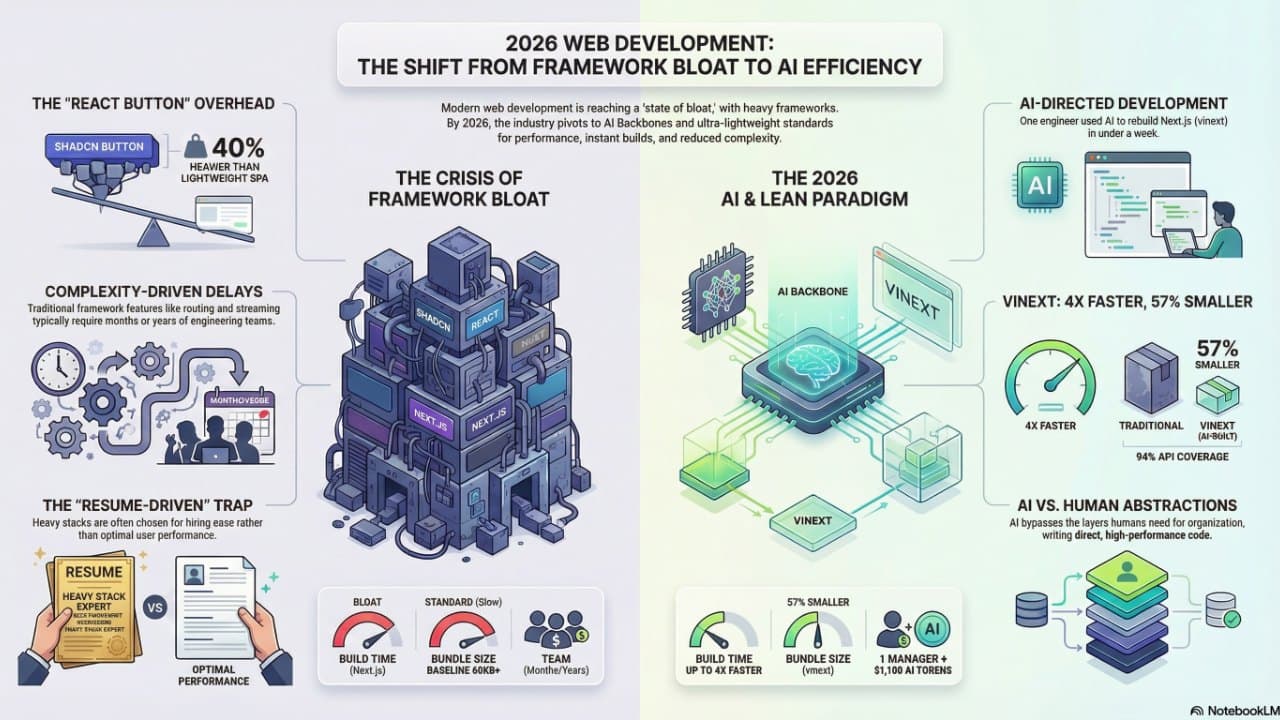
We are currently living through a grand architectural irony. We have spent billions laying high-speed fiber and perfecting low-latency peering, only to serve web pages that still take 10 seconds to reach a functional state. In an era of 10G connections, the modern dashboard has become a "Tower of Babel"—a massive stack of abstractions built not to serve the user, but to compensate for the limited mental context windows of human developers.
As we look toward 2026, the industry is hitting a breaking point. The bloat is no longer sustainable, and the tools we once viewed as essential are starting to look like dead weight. Here are the five radical realities redefining the web.
1. The Abstraction Paradox: Frameworks are UI for the Human Brain
Software abstractions—the layers, wrappers, and endless glue code—exist because humans are cognitively finite. We cannot hold a million-line system in our heads, so we build frameworks like Next.js to stay organized. But we are entering an era where the primary developer is no longer human.
Consider "vinext," an experimental project that achieved 94% coverage of the Next.js 16 API surface in a single work week. It wasn't built by a massive engineering team; it was built by one engineering manager directing an AI, costing a mere $1,100 in tokens.
While vinext remains an experimental proof-of-concept, it exposes a fundamental truth: AI doesn't need a "mental context window" limit. It needs a spec and a foundation. We are moving from a "Framework-First" era to an "Architecture-First" era.
2. The "Button" Crisis: When the Component Outweighs the App
Modern web development has fallen into the trap of "Resume-Driven Development" (RDD). We use massive libraries to perform simple tasks.
- The Problem: A standard button component using popular modern stacks (like ShadCN on Vite) can pull in 73KB of JavaScript before it even does anything.
- The Reality: New lean standards, such as Nue, demonstrate that an entire Single Page Application (SPA) can be smaller than that single button.
- The bloat: While typical projects have
node_modulesfolders exceeding 150MB, lean architectures are achieving the same results with just 2MB.
The vision for 2026 is a return to semantic purity: keeping HTML and CSS clean, and reserving static typing (Rust, Go, or TypeScript) strictly for business logic where it provides genuine value.
3. Bypassing the JavaScript Ceiling
Standard JavaScript is hitting a technical wall. For instance, the spread operator (...)—a staple of modern React development—can crash the browser thread by hitting "Maximum call stack size" when handling large datasets (approx. 110,000 records).
To solve this, 2026 will see the rise of Rust-powered engines running via WebAssembly (WASM). By moving heavy computation off the main thread, developers can perform high-density filtering and sorting on 150,000+ records at speeds that would cause standard React environments to seize.
4. Cloud 3.0: The AI Backbone
Infrastructure is evolving. We are moving past simple hosting into the era of "Cloud 3.0," where the cloud functions as an AI Backbone.
This infrastructure isn't just about storage; it is about providing the "ground truth" and actionable foundations that allow AI to generate entire frameworks and systems on the fly. This allows for:
- Strategic Intelligence: Using real-time data to drive investment and architectural decisions.
- Sustainable Growth: Lean architectures that scale without the exponential "bloat tax" of traditional clouds.
5. Vibe Coding and the "Surgical" Developer
The rise of "vibecoding"—AI-assisted development—represents a fundamental evolution in human-machine partnership.
Think of the modern architect as a surgeon using robotic tools. Previously, a surgeon was limited by the tremors and scale of human hands. With robotics, they can perform movements at a sub-millimeter scale with perfect precision.
Similarly, AI allows an expert engineer to execute complex system architectures at a "sub-millimeter" scale of precision. By leveraging proper terminology and deep web standards, a single architect can now achieve a 50x productivity leap, building in a week what once took an entire department a year.
Conclusion: Are We Building for the User or Our Own Limits?
The trajectory of the web is clear: the monolithic era is ending. The movement toward a "web standards first" philosophy promises smaller codebases, near-instant Hot Module Replacement (HMR), and a web that finally respects the user's time and hardware.
As we approach 2026, every CTO and Lead Architect must ask: "If an AI can rebuild our entire framework in a week, are we still building for the user, or are we just managing the limits of our own heads?"
The future is lean. The future is architecture. The future is lighter than a button.
Comments
Sign in with Google or GitHub to comment.