Beyond Autocomplete: How the Ruby Ecosystem is Pivoting for the Agentic Age
The industry is moving toward a standard where agents are active operators capable of long-horizon runs rather than just chat interfaces.
1. Introduction: The Shifting Sands of Ruby and AI
In early 2026, the Ruby on Rails community is navigating a period of profound architectural tension. On one side is "classic" Rails stability; on the other is the rapid surge of agentic AI. We are witnessing a decoupling of the UI from the logic layer as agents begin to take over complex workflows. This transition signals how Rails is evolving to meet the "Agentic Age".
2. The "Production-Shaped" Agent: Why the Sandbox is the New Standard
The industry is moving toward a standard where agents are active operators capable of long-horizon runs rather than just chat interfaces.
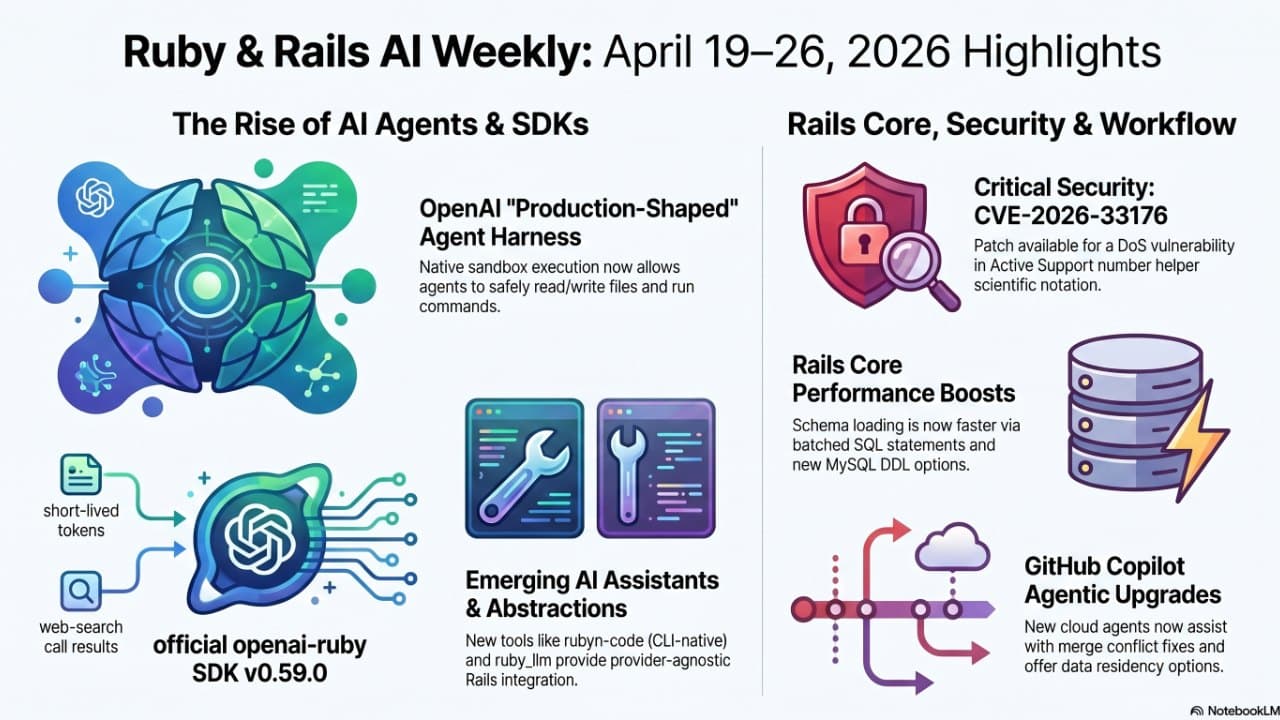
- Native Sandbox Execution: This allows agents to read/write files and execute commands in a controlled environment, solving the "Code as Data" security nightmare.
- OpenAI Ruby SDK (v0.59.0): Introduces critical infrastructure like short-lived token support, allowing for high security during ephemeral, high-privilege tasks.
- Shift in Focus: Developers are moving from building features to architecting autonomous execution environments.
3. Terminal-Native Intelligence: The Localization of Agency
There is a strategic pivot toward "localization of agency," moving intelligence closer to the metal and the monorepo.
- rubyn-code (v0.4.0): A specialized CLI assistant that uses local SQLite persistence and Claude OAuth to maintain state where the code lives.
- Benefits: Keeping agents in the local file system provides better auditability and lower latency.
- Context Awareness: Effective agents must understand project structure nuances from the inside out.
4. Strategic Abstraction: De-risking the LLM Stack
To avoid vendor lock-in amidst fluctuating LLM price-to-performance ratios, the ruby_llm (v1.14.1) gem has become essential for "architectural de-risking". It provides a single API supporting:
- Tools and Function Calling: Orchestrating application logic.
- Streaming: Delivering real-time, low-latency UX.
- Embeddings: Powering internal RAG workflows.
- Structured Output: Ensuring responses conform to schema definitions.
5. Security in the Small: The 1e10000 Threat Vector
"Boring" code remains a high-stakes liability, as seen in CVE-2026-33176 regarding Active Support number helpers.
- The Risk: Attackers can pass values like
1e10000, causing scientific notation expansion that consumes catastrophic CPU and memory. - Exposure: These helpers are often found in API serializers, making the Denial of Service (DoS) risk higher than it appears.
6. From Autocomplete to Agent: GitHub Copilot’s New Frontier
GitHub Copilot is transitioning from a suggestion tool to a collaborator.
- Workflow Upgrades: Cloud agents can now handle merge conflict fixes autonomously.
- Compliance: New data residency options address enterprise concerns.
- Volatility: The recent pause on Copilot Pro trials in April 2026 highlights that these tools are still in a period of unstable maturation.
7. Conclusion: The Roadmap to Rails 9 and Beyond
Rails continues to iterate with a focus on performance and modernization.
- Rails 9 Preparation: The planned removal of
require_dependencymarks the final move toward a cleaner constant loading system. - AI Safety: Standardized gems for prompt injection protection and audit trails are expected to become as essential as Devise or Sidekiq.
- Role Evolution: Developers are shifting from writing every line of code to being orchestrators and auditors of agents.
Comments
Sign in with Google or GitHub to comment.