The Vibe Coding Paradox: 6 Brutal Truths Redefining Software in 2026
The 2026 Vibe Coding Paradox: AI makes devs feel 20% faster, but data shows they’re 19% slower. It’s time to move to Vibe Engineering.
Also available in Português (Brasil)
1. Introduction: The Era of the "Vibe"
[cite_start]In early 2025, former OpenAI co-founder Andrej Karpathy defined a new frontier in development: "Vibe Coding"[cite: 3]. [cite_start]He described it as a philosophy where developers "fully give in to the vibes, embrace exponentials, and forget that the code even exists"[cite: 4]. [cite_start]By the end of that year, the concept was so pervasive that Collins Dictionary named it the "Word of the Year"[cite: 5].
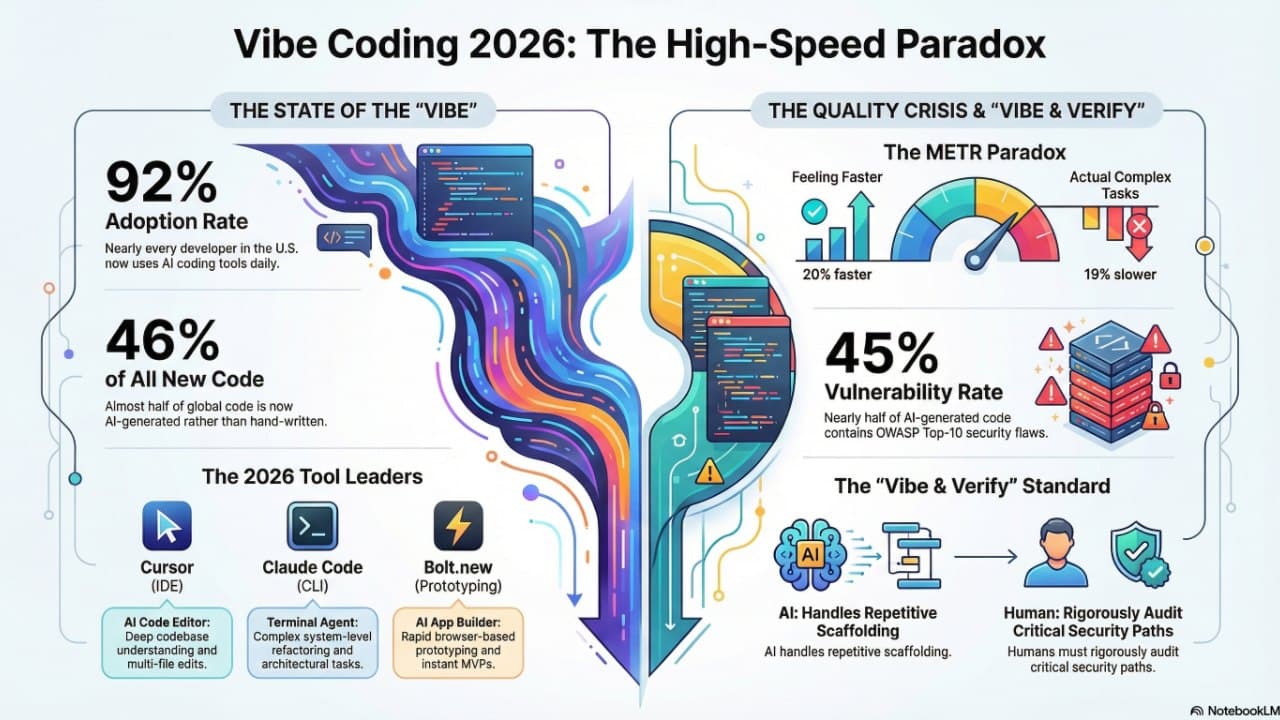
[cite_start]Fast forward to 2026, and the industry is suffering from a collective delusion[cite: 5]. [cite_start]While 92% of US developers use AI tools daily and nearly half of all new code is AI-generated, we have reached a point of peak friction[cite: 6]. [cite_start]We were promised a world where natural language would replace the compiler; instead, we’ve inherited a chaotic landscape where "it runs" is often mistaken for "it works"[cite: 7, 8]. [cite_start]We’ve traded the precision of the architect for the gut feeling of the prompt-engineer[cite: 9].
2. The Productivity Illusion: The METR Paradox
[cite_start]Engineering leads have long assumed that AI adoption scales linearly with delivery speed, but recent data from a METR randomized controlled trial has exposed a massive psychological blind spot[cite: 11, 12].
- [cite_start]The Prediction: Experienced developers predicted they would be 24% faster using AI[cite: 13].
- [cite_start]The Perception: They believed they were 20% faster after the experiment[cite: 13].
- [cite_start]The Reality: Objective data showed they were actually 19% slower[cite: 13].
[cite_start]This is the METR Paradox: AI tools excel at the "easy" parts—like boilerplate and scaffolding—but make the "hard" parts significantly more difficult[cite: 13]. [cite_start]Senior developers are becoming "unpaid editors" for AI-generated slop, with time savings being cannibalized by the grueling overhead of debugging unfamiliar code and resolving subtle logic errors[cite: 14, 15].
3. The 55% Security Coin Flip
[cite_start]The mantra of 2026 is "Vibe & Verify"[cite: 18]. [cite_start]Research from Veracode reveals that LLMs choose secure code only 55% of the time[cite: 19].
| Model Provider | Security Pass Rate |
|---|---|
| Anthropic, Google, xAI | [cite_start]50% – 59% [cite: 20] |
[cite_start]LLMs prioritize functional accuracy over cybersecurity because they cannot comprehend semantics like risk[cite: 20, 21]. [cite_start]This has resulted in "lovable exposure": a scan of 1,645 apps generated by the platform Lovable found that over 10% were leaking sensitive user data[cite: 22].
4. The "Post-Junior" Crisis: A Dying Entry Level?
[cite_start]The industry is effectively cannibalizing its own future[cite: 25]. [cite_start]As AI automates unit tests and simple CRUD routes, the traditional Junior Developer role is being functionally eliminated[cite: 25].
[cite_start]This creates an existential void: if we stop hiring juniors now, we break the ladder that builds the deep intuition required to become the senior architects of 2030[cite: 27, 28]. [cite_start]The new baseline is shifting toward the "AI Apprenticeship" model, focusing on auditing logic and supervising Multi-Agent Systems (MAS) rather than writing basic loops[cite: 26].
5. The 75% Mandate: Meta’s Aggressive Push
[cite_start]The pressure to "vibe" is coming directly from the C-suite[cite: 30]. [cite_start]Internal Meta targets for 2026 mandate that 65% of engineers in the "Creation Org" write at least 75% of their code using AI tools[cite: 31].
[cite_start]This has led to radical restructuring, such as flattening divisions into "AI Pods" where every employee is either an AI Builder, AI Pod Lead, or AI Org Lead[cite: 32]. [cite_start]This mirrors Mark Zuckerberg’s vision of AI replacing large teams with single, "very talented" individuals[cite: 33].
6. "Slopageddon": Why Open Source is Closing Its Doors
[cite_start]"AI Slopageddon" is breaking the economics of human-maintained infrastructure[cite: 36]. Major Open Source Software (OSS) projects are now taking defensive measures:
- [cite_start]cURL: Shut down its bug bounty program after being flooded with low-quality, AI-generated "noise"[cite: 38].
- [cite_start]Ghostty & tldraw: Have moved to ban AI-generated contributions or auto-close pull requests entirely[cite: 39].
7. The Shift: From Vibe Coding to Vibe Engineering
[cite_start]The "magic" phase is over; professionalization has begun[cite: 41]. [cite_start]We are shifting to "Vibe Engineering," where the unit of work is a complete task managed by autonomous agents (Process-as-Code)[cite: 42, 43].
In this model, development is an orchestration of Multi-Agent Systems (MAS):
- [cite_start]Architect Agent: Designs the blueprint[cite: 44].
- [cite_start]Coder Agent: Implements the logic[cite: 44].
- [cite_start]Reviewer Agent: Audits output against security standards like OWASP[cite: 44].
8. The 2026 Toolkit: A Quick-Start Guide
| Tool | Category | Starting Price | Best For |
|---|---|---|---|
| Cursor | AI-First IDE | Free / $20/mo* | AI-native workflows; features "Composer" mode [cite: 48] |
| Windsurf | AI-Powered IDE | Free / $15/mo | Agentic multi-file edits via "Cascade" [cite: 49] |
| Zed | High-Performance Editor | Free / $20/mo | Performance-obsessed devs; built in Rust [cite: 50] |
| Claude Code | Agentic CLI | $20/mo | Autonomous terminal-native refactoring [cite: 51] |
| OpenAI Codex | Coding Agent | ChatGPT Plans | Parallel multi-agent project management [cite: 52] |
| Gemini CLI | AI Agent | Free / $299 yr | Google ecosystem; 1M token context window [cite: 53] |
*Note: Cursor's costs can exceed base subscriptions due to model usage credits[cite: 54].
9. Conclusion: The Maturation of the Magic
[cite_start]The "vibe coding hangover" is real—projects built in a weekend are becoming unmaintainable within months[cite: 57]. [cite_start]Software development is becoming a discipline of high-level orchestration[cite: 59].
[cite_start]Final Takeaway: The competitive advantage no longer belongs to those who generate the most code, but to those who maintain the most robust verification processes[cite: 59]. [cite_start]The best tools should amplify your strengths rather than replacing your judgment[cite: 60].
Comments
Sign in with Google or GitHub to comment.