The Structural Reset: Consistency, Governance, and Real-Time Agentic Tech
The 2026 Structural Reset: AI mastery now depends on consistency and tenure, rather than just isolated prompt engineering techniques.
1. Introduction: The Velocity of 2026
The final weeks of March 2026 have produced a concentrated surge of "business-critical" updates that signal a profound architectural shift. We are no longer navigating incremental improvements; we are witnessing a structural convergence. High-velocity AI breakthroughs are merging with granular cloud residency shifts, just as the "end-of-life" for legacy runtimes creates a vacuum in the enterprise stack.
2. Takeaway 1: Your Prompting Skills Are Less Important Than Your "Stay" Power
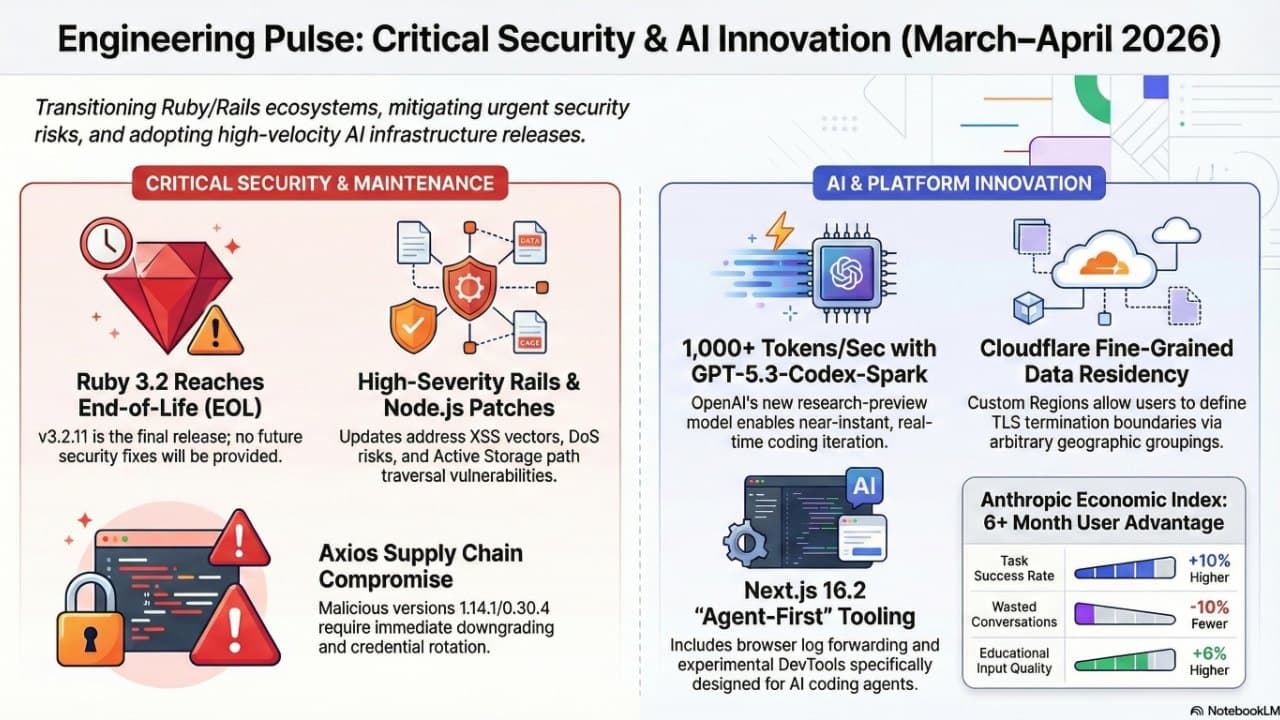
The Anthropic Economic Index (March 2026) has debunked the fallacy that "prompt engineering" is the sole differentiator of the AI productivity gap. While there is a $0.92$ correlation between prompt sophistication and output quality, the true "Experience Premium" is built on tenure.
- The Tenure Advantage: Users with 6+ months of continuous AI tenure exhibit a 10% higher success rate and 10% fewer wasteful queries.
- Iterative Mastery: Proficiency is less about "knowing how to ask" and more about the developed intuition for problem reframing and workflow automation.
- The Bottom Line: Consistency has become the only durable moat.
3. Takeaway 2: The Rise of "Pick and Mix" Data Sovereignty
Cloudflare’s "Custom Regions" move away from "region-first" models toward an edge-first architecture.
- Programmable Sovereignty: Organizations can define regions using expression-based membership (e.g.,
country_code == "TR") rather than fixed geographic data centers. - Precision Control: This allows for surgical control over where TLS termination and Layer 7 processing occur.
- Compliance: Sovereignty is now a programmable primitive for compliance-heavy industries.
4. Takeaway 3: The End of "Generate and Paste" (Real-Time Coding)
The release of OpenAI’s GPT-5.3-Codex-Spark and Next.js 16.2 marks the transition to agentic development.
- Ultra-Low Latency: Codex-Spark (via the OpenAI-Cerebras partnership) delivers over 1,000 tokens per second.
- Agent-Native Features: Next.js 16.2 introduces browser log forwarding and a dedicated
AGENTS.mdscaffolding. - Diagnostic Access: Experimental Agent DevTools give AI terminal access to see and fix errors in real-time.
5. Takeaway 4: React as a Public Utility
The React Foundation has been established under the Linux Foundation, transitioning React and React Native to a neutral, community-driven governance model.
| Category | Details |
|---|---|
| New Governance | Neutral, community-driven model |
| Platinum Members | Amazon, Microsoft, Vercel, and Huawei |
| Enterprise Benefit | Reduced vendor lock-in and long-term sustainability |
"By establishing the React Foundation... we are ensuring a strong, vibrant React for decades to come—guided by open governance and shared stewardship." — Seth Webster, Executive Director.
6. Takeaway 5: The "Ruby 3.2 Cliff" and Supply Chain Triage
Engineering leaders must now treat "supply-chain triage" as a weekly requirement due to mounting security risks.
- Ruby 3.2.11: This is the final release of the series; no further security fixes (including the critical CVE-2026-27820 zlib patch) will be backported.
- Axios Compromise: Malicious versions (
1.14.1and0.30.4) were found exfiltrating credentials via compromised accounts. - Node.js Vulnerabilities: Urgent releases address SNI callback exceptions and HashDoS in V8.
7. Conclusion: Mastery is a Craft
The industry is maturing toward neutral governance, real-time agentic integration, and experience-based mastery. The gap is closing for those who integrate these tools into their daily craft but widening exponentially for those waiting on the sidelines.
Comments
Sign in with Google or GitHub to comment.