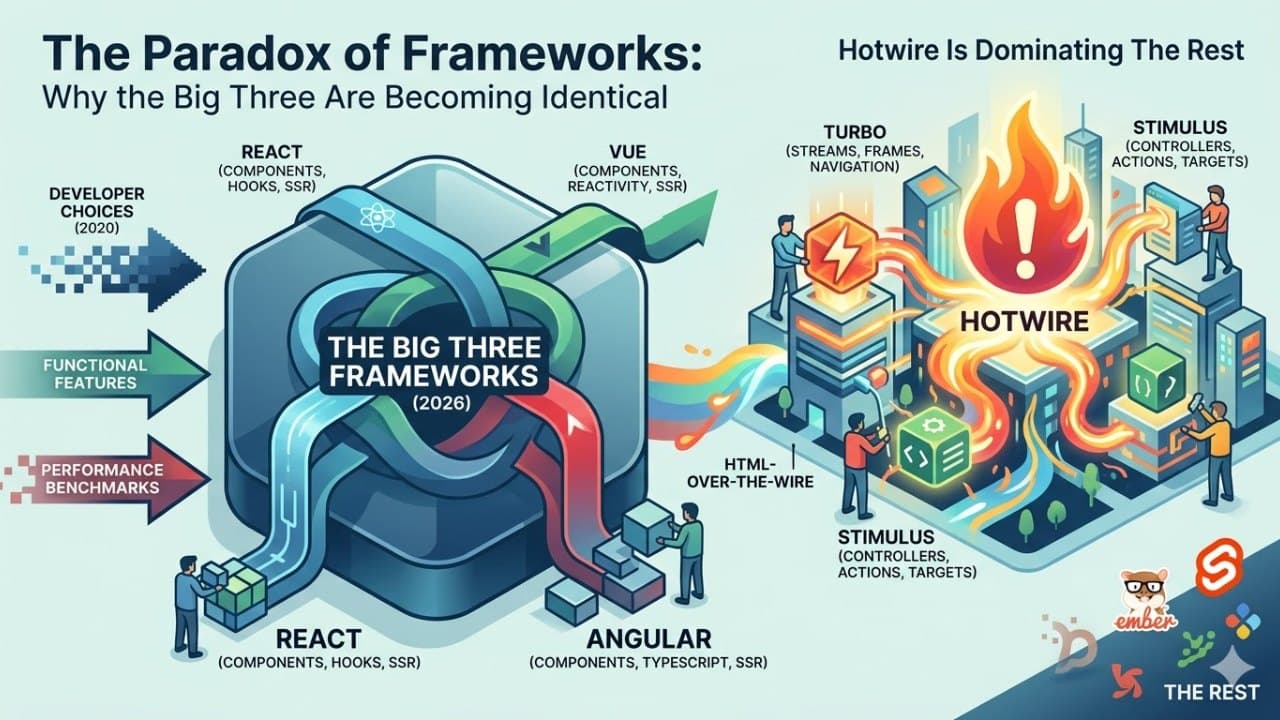
The 2026 Framework Paradox: Why the Big Three are Becoming Identical and Hotwire is Taking the Rest
"For over a decade, 'JavaScript Churn' has been the primary source of innovation and exhaustion in the engineering community. Endless cycles between Angular's heavy dependency injection, React's unidirectional data flow, and Vue's accessible elegance have pushed many system architects to the limit. We are tired of building monuments to framework complexity instead of products for users."
Why the Big Three are Becoming Identical and Hotwire is Taking the Rest
In 2026, the "Framework Wars" aren't ending because one library defeated the others. They are ending because of a massive architectural convergence. The industry’s leading technologies have finally agreed on what high-performance delivery looks like, and it’s a future defined by performance pragmatism rather than client-side dogmatism.
The Great Convergence: Everyone is Building the Same Engine
After years of competing philosophies, the "Big Three" have moved away from heavy Virtual DOM diffing toward a unified model of fine-grained, signal-based reactivity. Whether you are using Angular, React, or Vue, the "engine" under the hood is beginning to look remarkably similar.
- Angular 20 & 21 (Bundle: ~120KB): Google’s framework has achieved a resurgence by moving toward a "zoneless" architecture. By relying on Signals for explicit dependency tracking, Angular 21 has introduced Signal-based Forms, reducing template update churn by 15–25% and eliminating the performance overhead of zone.js.
- React 19.2 (Bundle: ~35KB): The industry standard has integrated the React Compiler to automate memoization, effectively killing the manual overhead of useMemo. Architecturally, the introduction of the use() hook has simplified asynchronous data handling, allowing React to handle server-to-client transitions with much lower hydration latency.
- Vue 3.5 (Bundle: ~20KB): Vue’s Vapor Mode allows components to bypass the Virtual DOM entirely, compiling them into highly efficient, direct DOM-manipulation code. This achieves near-native performance while maintaining the modularity of its Composition API.
This convergence represents a shift from "Virtual DOM reconciliation" to "micro-portal logic" where only the exact node that changes is touched. The frameworks have stopped fighting over how to define a component and started competing over who can get the most code out of the client-side bundle.
The 90% Rule: Why "HTML Over the Wire" is Winning
While the Big Three optimize their JS engines, a "pragmatic" movement led by Hotwire (Turbo and Stimulus) is capturing the vast majority of the SaaS market. The core architectural insight of 2026 is simple: Put the code where your data is.
When 90% of your application logic consists of Admin CRUD, settings pages, and standard data entry, moving that authority to the client is an architectural anti-pattern. Hotwire’s "HTML Over the Wire" approach sends fully rendered fragments from the server, treating the browser as a thin client rather than a heavy application runtime.
As the team at The Pragmatic Studio notes:
"Building modern frontends has become complex. Like, really mind-busting. But Hotwire lets you build modern, interactive frontends while taking a pass on climbing the mountain that is 'The JavaScript Ecosystem.' Because Hotwire is Rails-y... it's mostly server-rendered HTML using all the familiar goodies."
By using Turbo Frames to localize updates and Turbo Drive to intercept navigation, developers can maintain the "Single-Page Application" feel without the "Single-Page Application" state-synchronization nightmare.
The "Real-Time Tax" You Aren't Factoring In
However, as a Systems Architect, I must warn against the "Dark Side" of real-time-everything. Many teams are finding that "real-time isn't free," and the hidden infrastructure costs are staggering.
- DOM Explosion: Every reactive state change or Turbo Stream update can leave old nodes orphaned in the tree. We are seeing long-lived dashboard pages bloat to over 10,000 elements, resulting in a 5-second lag when clicking simple buttons and frequent Chrome crashes on mobile devices.
- WebSocket Stampedes: Maintaining 10,000 persistent WebSocket connections through Action Cable and Redis is an infrastructure nightmare. Some teams have seen their server bills double just to support non-essential "typing" indicators or low-value notifications.
- The Golden Rule: Real-time should be used for enhancements, not as a total replacement for the standard request-response cycle. If the data isn't changing every second, don't pay the WebSocket tax.
Native Apps Without the Native Team
One of the most profound shifts in 2026 is the death of the "separate mobile team" for small-to-medium startups. Hotwire Native allows teams to use a "Web-first" approach for iOS and Android.
By wrapping a web view within a native shell, your Rails or server-side backend handles the business logic, while Bridge Components provide high-fidelity native polish for SDK-specific features like the camera, haptics, or maps. The massive architectural win here? You can ship UI updates and bug fixes instantly without waiting for App Store reviews. This empowers non-specialist teams to maintain a global mobile presence with the same velocity as a web team.
The Hybrid Verdict: The "Island" Architecture
The most successful apps of 2026 have abandoned framework purism. They adopt an "Island" architecture—a sea of fast, server-rendered HTML punctuated by "islands" of high-complexity JavaScript where the UX truly demands it.
| Feature Type | Recommended Technology | Why |
|---|---|---|
| Admin CRUD | Hotwire (Turbo Frames) | Simple, fast iterations; state lives on the server where the data is. |
| Complex Data/Charts | React or Vue | High-frequency client-side state changes and complex re-renders. |
| Notifications | Turbo Streams | The "Island" of real-time; low-frequency, high-value updates via WebSockets. |
| Mobile App Shell | Hotwire Native | Rapid deployment; bypasses App Store review cycles for 90% of UI changes. |
Conclusion: Beyond the Choice
In 2026, the question is no longer "Which framework is the fastest?" Performance is no longer defined by the library you choose, but by your delivery strategy. Whether you are utilizing Angular's zoneless signals or Hotwire's server-side fragments, the goal is the same: reducing the "JavaScript tax" on the user.
As you architect your next system, look past the hype. Ask yourself: "In 2026, are you building a product for your users, or a monument to your framework's complexity?" The era of the monolithic JS framework is dead. The era of the pragmatic, hybrid web is here.
Comments
Sign in with Google or GitHub to comment.