Ruby, Rails & AI Weekly Roundup: Ruby 4.0.3 Security Patch, RubyKaigi 2026, and the GPT-5.5 Launch (April 20–26, 2026)
Ruby 4.0.3 security patch, RubyKaigi 2026 keynotes, This Week in Rails highlights, plus GPT-5.5 and Google's AI agent push.
Ruby, Rails & AI Weekly Roundup: Ruby 4.0.3 Security Patch, RubyKaigi 2026, and the GPT-5.5 Launch (April 20–26, 2026)
The week of April 20–26, 2026 gave Rubyists a security release worth acting on, a landmark conference in Hokkaido, a dense edition of This Week in Rails, and one of the most competitive weeks in frontier AI so far. Here's everything that mattered.
Ruby 4.0.3: patch now
On April 21, the Ruby core team released Ruby 4.0.3. The release landed alongside a security advisory for CVE-2026-46727, a use-after-free vulnerability in the pthread-based getaddrinfo timeout handler. A memory-safety bug sitting in name-resolution code is not something to leave in production, so if you're on the Ruby 4.0 line, this upgrade belongs in your current sprint. Teams still on 3.x should check the corresponding backport advisories.
RubyKaigi 2026 in Hakodate
From April 22–24, the global Ruby community gathered at Hakodate Arena in Hokkaido, Japan, for RubyKaigi 2026 — roughly 70 talks across three days, anchored by three keynotes.
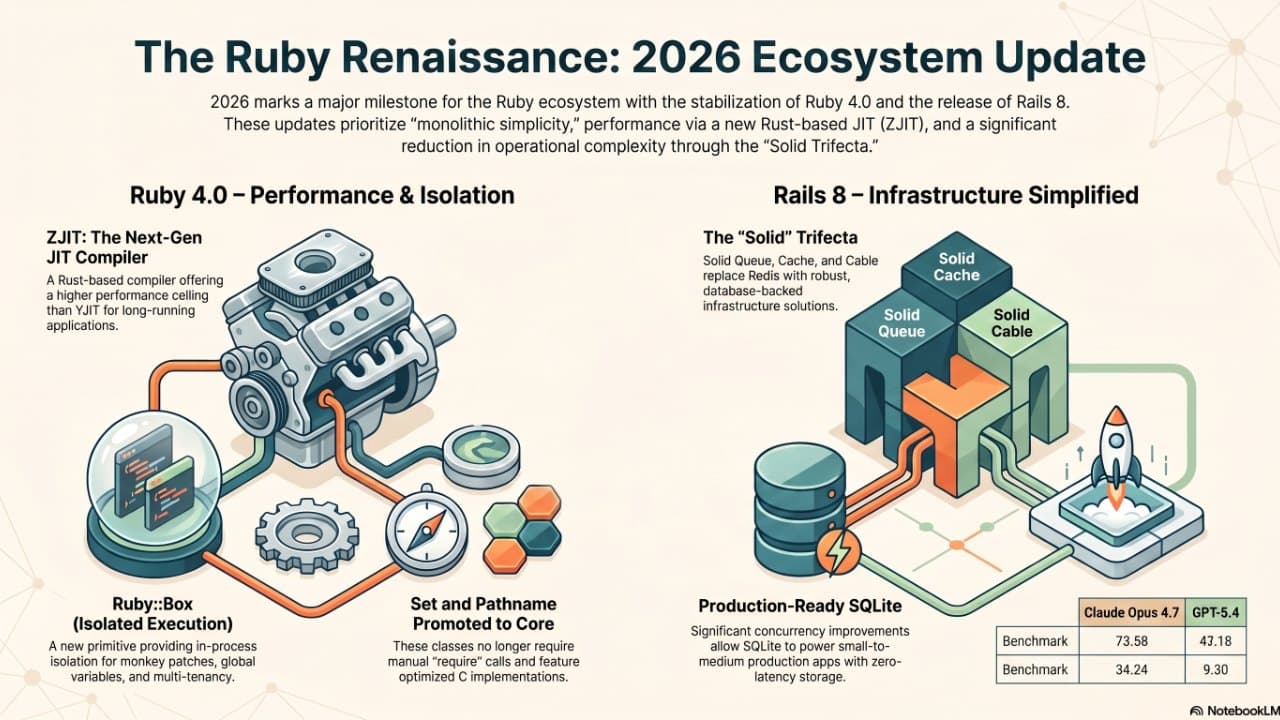
Satoshi Tagomori opened with "The Journey of Box Building," telling the story behind Ruby::Box, Ruby 4's experimental in-process isolation mechanism. For anyone fighting test isolation or exploring isolated app boxes for blue-green-style rollouts, this is the primitive to watch.
Charles Oliver Nutter marked twenty years of JRuby — the first JIT compiler for Ruby, true parallel threads, and the only alternative Ruby deployed at real scale — with JRuby 10.1 still shipping new features and optimizations.
Yukihiro "Matz" Matsumoto closed the conference, as tradition demands, and the city of Hakodate lit up Goryōkaku Tower in red to celebrate the event. Next year, RubyKaigi heads to Miyazaki.
This Week in Rails: sharp edges and quality-of-life fixes
Friday's edition of This Week in Rails, written by Claudio Baccigalupo, was dense with meaningful changes to the Rails codebase, with twelve contributors that week.
Rails main bumped the minimum supported PostgreSQL version to 10.0. Rails had still been claiming support for PostgreSQL 9.3, which is incompatible with PostgreSQL 18 — so if you're running an ancient Postgres, the deprecation clock is officially ticking.
add_column now raises when null: true is passed for a primary key. Previously the option was silently ignored, since primary keys receive a NOT NULL constraint unconditionally. Loud errors beat silent no-ops in migrations every time.
On the performance side, merging Active Record relation extensions via extending is now roughly twice as fast. A subtle connection-management bug was also fixed: nested with_connection calls no longer incorrectly clear a sticky lease set by lease_connection.
The strangest fix of the week involved Active Storage video previews. Rails spawns ffmpeg as a subprocess to generate previews, and ffmpeg watches for keypresses; under certain process-group setups, this caused Rails to receive a TTOU signal and hang indefinitely. That's now resolved.
Beyond the codebase, the 2026 Ruby on Rails Community Survey opened, and Rails World 2026 in Austin, Texas began accepting speaker applications, with corporate tickets on sale and general admission tickets releasing May 12.
Editorial pick: "The Rails Way in 2026"
On April 24, Arkency published "The Rails Way in 2026," naming the pattern they consistently find in production codebases: a fat model with a callback that triggers a service object executed as a background job, with process state living inside Active Record. The post doesn't condemn the pattern — it names it, so the community can have an honest conversation about when it serves us and when it doesn't. If you maintain a large Rails application, you'll recognize your codebase in that sentence.
AI: GPT-5.5 answers Claude Opus 4.7, Google bets on agents
The AI arms race compressed to a weekly cadence. Anthropic had shipped Claude Opus 4.7 on April 16, with a jump of more than ten points on SWE-bench Pro. Exactly seven days later, on April 23, OpenAI released GPT-5.5 (codename "Spud") — the first fully retrained base model since GPT-4.5, natively omnimodal, with a one-million-token context window and significant token-efficiency gains on agentic coding workloads. Two flagship models, one week apart, converging on the same context size: the differentiation has moved to orchestration, cost per completed task, and reliability.
Meanwhile, Google Cloud Next '26 ran April 21–22 and planted its flag firmly on the enterprise side: the Gemini Enterprise Agent Platform for building, deploying, and governing AI agents at scale; an "Inbox" for centralized agent management; a Knowledge Catalog that builds a semantic graph across enterprise data using Gemini; and eighth-generation TPUs. Google reported its API now processes more than 16 billion tokens per minute.
For those of us shipping Rails applications, the takeaway is pragmatic: models and context windows are converging, and the real differentiators are becoming agent governance, orchestration, and cost efficiency. Convention over configuration is starting to sound like an AI strategy.
Action items for the week
Patch to Ruby 4.0.3, watch the RubyKaigi 2026 talks as they land on RubyEvents, fill out the Rails Community Survey, apply to speak at Rails World 2026 before GA tickets drop on May 12, and re-evaluate which frontier model powers your coding agents.
Comments
Sign in with Google or GitHub to comment.