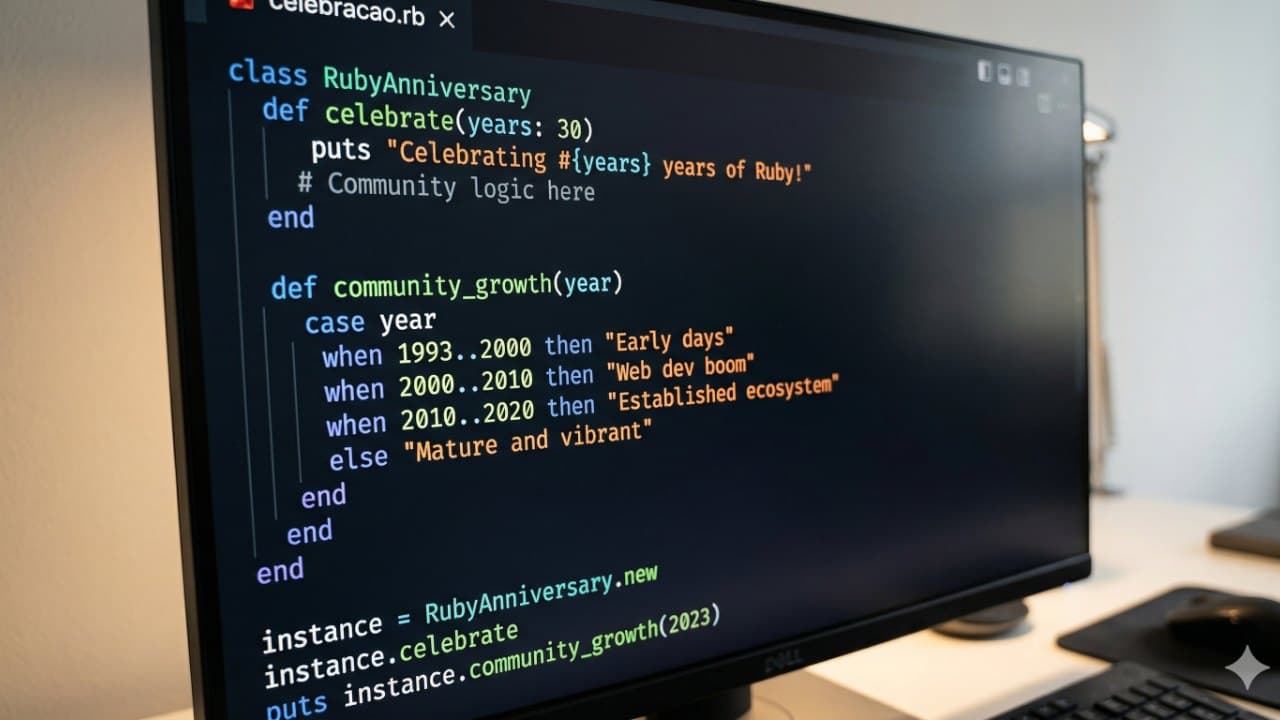
30 Years of Ruby
Ruby just turned 30. Conceived in 1993 and publicly released in 1995, the language has evolved from a developer-friendly alternative to traditional object‑oriented languages into a mature ecosystem and a thriving global community. With its expressive syntax, focus on developer happiness, and ability to deliver software quickly and sustainably, Ruby remains one of the most beloved languages in the industry.
Ruby Turns 30: Three Decades of Elegance, Productivity, and Community
It is remarkable to think that Ruby has now turned 30. The language was conceived on February 24, 1993, in a conversation between Yukihiro Matsumoto (Matz) and Keiju Ishitsuka, and its first public version, Ruby 0.95, was announced on December 21, 1995. Since then, Ruby has become one of the most admired programming languages in the industry for its expressive syntax, its focus on developer happiness, and its ability to help teams build software quickly and sustainably.
Across these three decades, Ruby became far more than a language. It grew into an ecosystem, a global community, and, for many developers, a more human way to program. What started as Matz’s search for a language that was more object-oriented and more enjoyable to use went on to influence generations of engineers and modern frameworks.
1993 and 1995: The Origin of a Language Built for People
Ruby was born from a very clear intention: to create a language that placed the developer at the center of the experience. Matz wanted a language that was truly object-oriented, simple to use, powerful, and pleasant. That philosophy continued to guide Ruby over the years and helps explain why the language built such a loyal community.
In 1996, Ruby 1.0 arrived. By 1998, the language had already begun expanding beyond Japan, with an English homepage, international mailing lists, and version 1.2, considered the first stable release. Soon after, Ruby was surpassing other languages in popularity in Japan and beginning to draw attention across the rest of the world.
2001 to 2005: Global Growth and Community Consolidation
The early 2000s were decisive. In 2001, the first RubyConf took place and the first major English-language book, Programming Ruby, known as the “Pickaxe,” was published. In 2003, Ruby 1.8 arrived as an important milestone in the language’s maturity. In 2004, RubyGems was introduced, permanently changing the way libraries would be distributed and consumed in the Ruby ecosystem.
During the same period, David Heinemeier Hansson extracted and released Ruby on Rails as open source. That was a turning point. Rails pushed Ruby to the center of modern web development, popularizing conventions, extreme productivity, and the idea that building web applications could be elegant and fast. In 2005, with the release of Rails 1.0, Ruby reached a new level of international adoption.
2013 to 2024: From Technical Maturity to Continuous Evolution
Ruby’s trajectory did not remain tied to the early Rails hype. The language kept evolving. In 2013, Ruby 2.0.0 marked a new cycle of stability and technical refinement. After that came important advances in performance, ergonomics, concurrency, parsing, JIT compilation, and tooling.
On December 25, 2024, the Ruby project announced Ruby 3.4.0, bringing additions such as it as a block parameter reference, Prism as the default parser, improvements to YJIT, support for Happy Eyeballs v2 in the socket library, and a Modular GC. It was another consistent step in Ruby’s strategy of staying modern without sacrificing readability and productivity.
2025 and 2026: 30 Years of Ruby and What Comes Next
Then, on December 25, 2025, right in the context of Ruby’s 30th anniversary celebration, Ruby 4.0.0 was released. That release introduced features such as Ruby Box and ZJIT, reinforcing that Ruby remains active, relevant, and technically ambitious even after three decades. By March 2026, the 4.0 series was already continuing its maintenance cycle with Ruby 4.0.2, showing that the project remains in full evolution.
2026: Why Ruby Still Matters
In an industry obsessed with novelty, Ruby remains relevant for a simple reason: it continues to solve real problems with an excellent balance of clarity, development speed, and long-term maintainability. Ruby remains a strong choice for digital products, SaaS platforms, APIs, automation, internal scripts, and complex applications that value team productivity and readable code.
More than that, Ruby has preserved something rare: identity. Few languages have maintained such a clear philosophy for so long. Ruby still insists that software should not only be efficient for machines, but also understandable and enjoyable for human beings. That vision may be its greatest legacy.
1993 to 2026: Ruby’s Legacy
Celebrating Ruby’s 30th anniversary is not just about looking back. It is about recognizing a language that helped shape modern web development, built an extremely influential community, and continues to evolve with consistency.
From 1993 until today, Ruby has crossed technological generations, survived industry trends, and remained faithful to its original purpose. That alone would already be notable. But Ruby did more than survive: it remained relevant, elegant, and inspiring.
Congratulations to Ruby, its community, and all the developers who helped build this history. Here is to the years ahead.
Comments
Sign in with Google or GitHub to comment.